Figuring​ the Impact of Social Media Contents: The ‘Response Calibration Index’

response-calibration-index.jpg

Original Response/Calibration Factor

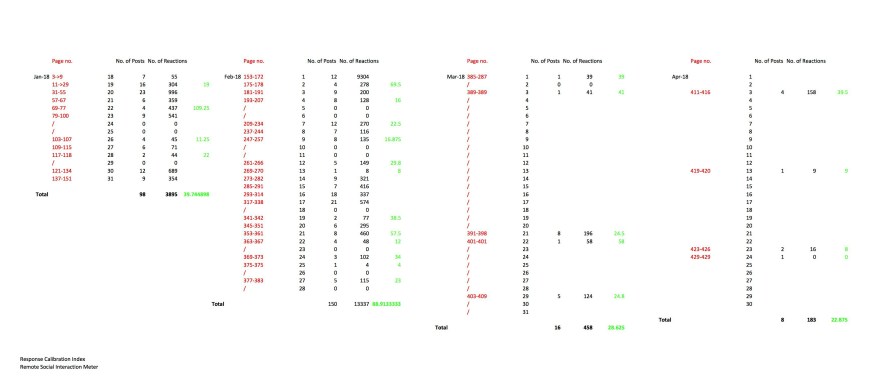
The ‘Response Calibration Index’ (RCI) reflects the level of affectiveness imposed by social media contents to its users. In each of the day recorded, the higher the index, the more fluctuate the emotion undergone by the social media users.

*This calculation method is developed during the research for my studio project.

Book making: experiements


Mockups (Japanese, kettle stitch and perfect binding) for ‘only those we’ve encountered, existed.’ (2018)

Tried different binding methods and grids for the book and decided to use kettle stitch binding. Tracing paper will be used for the session starter pages as a hint on how emotion react with the contents.

Record: idea development

Who Are The Artists? Thinking Of Identities (Personal Struggle on refusal to regard me as an artist) (Psychological Change in facing own identities and through constructing new identities)

Attempt To Override Embedded Values In Jewellery (Success? Should We override or should we use it as a tool?)

Stage 1: Idea of Brokering Identity (Mid-term Exhibition)

Soul Bank: An Idea to uphold Equality of Identities with Jewellery

Stage 2: Becoming a Story Collector (Amendments)

Conversation As A Way Of Research (Describe and show the outcomes of my attempt to collect story; Psychological aspect to try)

Story Telling as Art Practice (Soul Bank and my literary practice are all storytelling, my previous works as well) (Visual Presentation in Story Telling, e.g. The colour coding system)

Stage 3: Exploring Technology

Art and Technology: Online transaction, 3D printing, Social Media, and their relation to Storytelling

Recording Daily Activities As A Way Of Research (Social Media story and the most used words, emotions, feelings)

Stage 4: Reflection & Production

Recurring Social Media Contents (during book making process): A process in Facing Traumas (from social events) & Concretising Memory
Social Psychology and Emotion Recognition: Parkinson, Brian. (2008). Emotions in direct and remote social interaction: Getting through the spaces between us. Computers in Human Behavior. 24. 1510-1529. 10.1016/j.chb.2007.05.006.
Facebook crisis: a catalyst for​ the rematerialisation of social life?

983791646239109120-png__700

I have been capturing and arranging Facebook posts that I’ve read since January this year for my project. So recently, when the Cambridge Analytica incident fermented, I have been thinking about the nature of my project, and what my intention to record those information has to do with the life cycle of social media (identifying a need→born of an idea→establish of platform→thrive→new problem→disposal whether the whole platform of certain values→reidentifiying a need) reveals by the incident.

I must have had too much time to watch through the whole two-days congress testifying (aha!) but it pretty much tells the world about the nature of the business that ‘could not be categorised’. (werunadswerunadswerunadswerunads)

Apparently, the reality is, as it always have been in these days, more dramatic and severe than what creative individuals trying to create in their works. A renowned actor and one-act comedian in Hong Kong announced his retirement last year because “there isn’t a need for one-act comedies anymore”. The city, or at least his audiences, need not get to know the preposterous reality through his plays anymore.


Related: Freud and Literature

So we have been living in an age that we are so influenced by Freud’s modern physcology and psychoanalysis without actually knowing it, creative works and productions are deeply affected by his studies. Here, The Victorian Web suggested Freudianism’s connection with literature by bringing up a method of investigation: (1) treat literary works from the vantage point of psycho-biography; (2) search for “obsessive” repetitions within the work; (3) look into Freud’s comparisons between dreams and poetic language & structure. The following questions had been asked by the author:

Screen Shot 2018-02-21 at 11.26.18 PM

A more detailed interpretation of Freud’s influences on social and cultural studies could be found on Britannica.

What do we learn from Nataša Petrešin-Bachelez’s Slow Institutions

New worlds could be created in response to traumas of the past and present.

In the lectures on two symposiums on the idea of resilience (also her curated show Resilience: U3—Triennial of Contemporary Art in Slovenia in 2013), Nataša Petrešin gave an emotional pursuation to art institutions in retreating from progress-driven modes of living and thinking to what I interpreted as ‘ecologies’ that establish connections between all memebers of institutions whom being seen as living and breathing organisms within each habitat.