The Serving Library http://www.servinglibrary.org
Paul Chan, Badlands Unlimited https://badlandsunlimited.com
Triple Canopy https://www.canopycanopycanopy.com
full of breadcrumbs.
The Serving Library http://www.servinglibrary.org
Paul Chan, Badlands Unlimited https://badlandsunlimited.com
Triple Canopy https://www.canopycanopycanopy.com
Recently I have come across a very interesting website. Sponsored by The School of Life, The Book of Life discuss the function of traditional publication in modern times in their introduction:

In the chapter CAPITALISM > GOOD CAPITALISM, one article discussed “how the modernworld makes us mentally ill“, in which the writer listed meritocracy, media and individualism as three main elements that generate “the forces of psychological distress in our world”. The analysis are, not so surprisingly, an interpretation from another angle of my in-progress project.


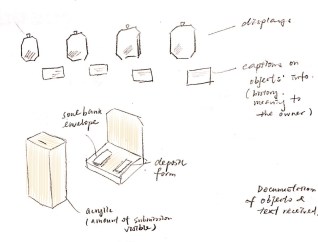
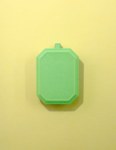
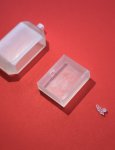

It was four years ago when I first work with 3D printing and scanning. It has been developed into a widely applied technology with a range of materials available to choose from. These are actually better than I expected, and I would probably apply the translucent quality in my upcoming project.
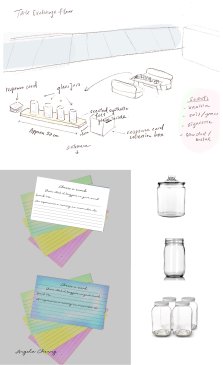
Sculpting in virtual world is surreal. I think traditional craft people would definitely be inscure doing this. I remember having a discussion in IP class about whether 3D files (materially a bunch of source codes) are considered as computer programs? Sculptures? Literature? or…
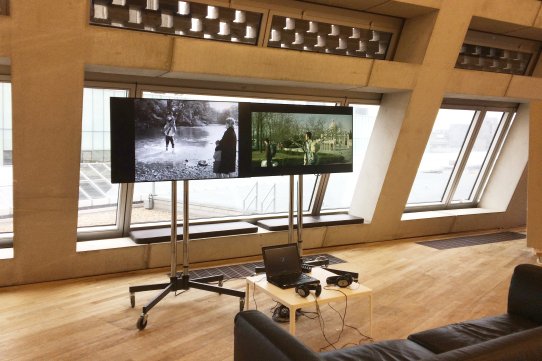
Performing arts is a process of identity construction. It requires immersion into another experience and life in order to act vividly; playwrights do editing the plays – like storytellers edit the source of stories collected. In the process, creative decisions are made, new pieces of a creative expression are orchestrated, and, most importantly, they are made to be told / shown / performed.
I am delighted to be involved in Reading Assembly and to perform parts from Lungs by Duncan Macmillian and Oil by Ella Hickson. The plays discuss a mixture of vital social issues including ecology, politics, immigrants, etc. The plays provide a few stepping stone for analysing the authors’ viewpoint on these topics. The display, Utopia / Dystopia, at the Reading Assembly, Tate Exchange would be focusing on the ecology aspect. It will follow by a panel discussion on London 2050.
Keeping a Glossary helps to construct information for revisiting in the future; it might as well be a creative methodology that helps to locate a subject matter, or identify materials that could potentially become part of a work. This glossary is the physcology terms that I came across during my research for the Soul Bank project. They would be arranged into a graph at the end of my research:
Retrospective Memory Where the content to be remembered (people, words, events, etc) is in the past, i.e. the recollection of past episodes. Prospective Memory Where the content is to be remembered in the future, and may be defined as “remembering to remember” or remembering to perform an intended action. Multidetermination describes behaviors of any individual which are considered to be influenced by more than one variable such as genetics and environmental factors. Object Permanence (developmental physcology) is a child’s ability to know that objects continue to exist even though they can no longer be seen or heard by developing a mental representation of the object called schema (Originated Greek: skhēma, shape, plan), a category of knowledge about something in the world, e.g. an infant might have a schema for food, which during early infancy will be either a bottle or breast. Emotional Creativity the ability to experience and express original, appropriate, and authentic combinations of emotions. People with a high EC tend to generate original emotional reactions that benefit creativity (Ivcevic et al., 2007). Emotional Intelligence is characterized by the individual’s ability to identify, understand and express, regulate and use their own emotions and the emotions of others (Salovey and Mayer, 1990; Bisquerra and Pérez-Escoda, 2007; Peña-Sarrionandia et al., 2015). The processes of emotional regulation may favor an improvement of thought and enhance creative processes (Gross, 2013; Medrano et al., 2013).
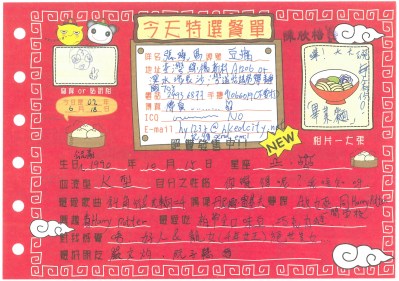
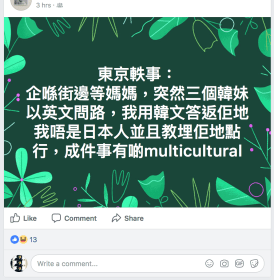
On the left:
In my primary and college school days, on the day of graduation we would give each of our fellow classmates a piece of, kind of a questionnaire to fill in, as a proof of friendship. There were two kinds of questions on the pre-printed questionnaire that the kids of my culture have to fill in: firstly their personal information, and secondly their impressions on the one who gave you the questionnaire. Most people would fill and return it, because they would also like to have their questionnaire back from the others too. Often there is quite some seen on the paper, such as ‘my pen is blue, my friend is you’ (a lyric from a pop song), Forever Friends (the Hallmark classic figure), etc.
The point I want to make is, we have been borrowing stuff from popular culture, symbols to consturct our own sense of affection and expression from an early age. Something that is not new, something we are already doing before the technological era.
Even I am reading my own hand writings now, I had no idea that I have ever written these kind of things before. I thank my generous childhood company who sent this back to me on my request.
The following thinking started with the consideration of documentation get the stories or the process as a whole in the form of a book or not.
When there is no digital transmission platform, documentation was existed in the form of books for a good reason. Paper form of documentation was either for a physical record of the happening, or for broadcasting and communicating the matters concerned in those processes being documented. But in the age of digitisation where everyone is involved in all different sort of processes, does tangible documentation still in need?
One thing that I was wondering when thinking about this question is what purpose(s) does the documentation serve. If it is documenting the process for more people to see it — then I can’t see the reason why one would not have chosen social media instead? Or reading through my previous line you probably would argue that publication, online or offline, are materially different in nature (that explains the phenomenon of writers jumping off the ship of Facebook to “”). How different are they really, in terms of materiality? Online platforms with different designs and functions requires a set of common conditions to operate, and their goal are similar — to attract more users.(Afterall, it was a choice that we opted in to) If online platforms achieve this mission better that a tangible documentation– why do we still need a tangible one?
Second thing that came to m mind. Even Instagram could do the job of a book. An Instagram account named uploaded (no) illustrations that compose as a whole as a documentation of the scene at the Occupying Central. It became timeless once it has been uploaded to Instagram. A ‘Like’ could be given, footprints of accounts refreshes, every minute every day after.
However . And for such reason I am emphasising that as a pragmatist, what I mean is Online Platform could do the job better than a book; apparently books could not be replaced. Yet, isn’t challenging the status-quo by changing the way social media was intended to be an act of art? The attempt to make space within rules are what we need, instead of walking away.
The political movement had accelerate the rather static art scene in Hong Kong, once the gallery and governmental museum was dominant in defining and showing art. After taking over the public spaces (a test run for not only the political utopia, but many other aspect of life), a group of the public are more willing to step up and adventure on alternatives, which were highly discouraged before. Just don’t know where would this movement bring us to in sooner future.

 Hare out of (its) cave