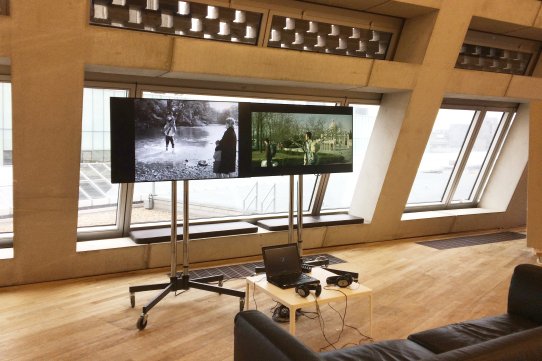
Audio work at Reading Assembly, Tate Exchange


IMG_2988.jpg
Utopia, Dystopia (2018), Film, Theatre & Television Department
School of Arts and Communication Design at Tate Exchange


Performing arts is a process of identity construction. It requires immersion into another experience and life in order to act vividly; playwrights do editing the plays – like storytellers edit the source of stories collected. In the process, creative decisions are made, new pieces of a creative expression are orchestrated, and, most importantly, they are made to be told / shown / performed.

I am delighted to be involved in Reading Assembly and to perform parts from Lungs by Duncan Macmillian and Oil by Ella Hickson. The plays discuss a mixture of vital social issues including ecology, politics, immigrants, etc. The plays provide a few stepping stone for analysing the authors’ viewpoint on these topics. The display, Utopia / Dystopia, at the Reading Assembly, Tate Exchange would be focusing on the ecology aspect. It will follow by a panel discussion on London 2050.

My Glossary: Physcology Terms

Keeping a Glossary helps to construct information for revisiting in the future; it might as well be a creative methodology that helps to locate a subject matter, or identify materials that could potentially become part of a work. This glossary is the physcology terms that I came across during my research for the Soul Bank project. They would be arranged into a graph at the end of my research:

Retrospective Memory Where the content to be remembered (people, words, events, etc) is in the past, i.e. the recollection of past episodes. Prospective Memory Where the content is to be remembered in the future, and may be defined as “remembering to remember” or remembering to perform an intended action. Multidetermination describes behaviors of any individual which are considered to be influenced by more than one variable such as genetics and environmental factors. Object Permanence (developmental physcology) is a child’s ability to know that objects continue to exist even though they can no longer be seen or heard by developing a mental representation of the object called schema (Originated Greek: skhēma, shape, plan), a category of knowledge about something in the world, e.g. an infant might have a schema for food, which during early infancy will be either a bottle or breast. Emotional Creativity the ability to experience and express original, appropriate, and authentic combinations of emotions. People with a high EC tend to generate original emotional reactions that benefit creativity (Ivcevic et al., 2007). Emotional Intelligence is characterized by the individual’s ability to identify, understand and express, regulate and use their own emotions and the emotions of others (Salovey and Mayer, 1990; Bisquerra and Pérez-Escoda, 2007; Peña-Sarrionandia et al., 2015). The processes of emotional regulation may favor an improvement of thought and enhance creative processes (Gross, 2013; Medrano et al., 2013).

Is there a need for tracing processes?

The following thinking started with the consideration of documentation get the stories or the process as a whole in the form of a book or not.

When there is no digital transmission platform, documentation was existed in the form of books for a good reason. Paper form of documentation was either for a physical record of the happening, or for broadcasting and communicating the matters concerned in those processes being documented.  But in the age of digitisation where everyone is involved in all different sort of processes, does tangible documentation still in need?

One thing that I was wondering when thinking about this question is what purpose(s) does the documentation serve. If it is documenting the process for more people to see it — then I can’t see the reason why one would not have chosen social media instead? Or reading through my previous line you probably would argue that publication, online or offline, are materially different in nature (that explains the phenomenon of writers jumping off the ship of Facebook to “”). How different are they really, in terms of materiality? Online platforms with different designs and functions requires a set of  common conditions to operate, and their goal are similar — to attract more users.(Afterall, it was a choice that we opted in to) If online platforms achieve this mission better that a tangible documentation– why do we still need a tangible one?

Second thing that came to m mind. Even Instagram could do the job of a book. An Instagram account named uploaded (no) illustrations that compose as a whole as a documentation of the scene at the Occupying Central. It became timeless once it has been uploaded to Instagram. A ‘Like’ could be given, footprints of accounts refreshes, every minute every day after.

However . And for such reason I am emphasising that as a pragmatist, what I mean is Online Platform could do the job better than a book; apparently books could not be replaced. Yet, isn’t challenging the status-quo by changing the way social media was intended to be an act of art? The attempt to make space within rules are what we need, instead of walking away.

The political movement had accelerate the rather static art scene in Hong Kong, once the gallery and governmental museum was dominant in defining and showing art. After taking over the public spaces (a test run for not only the political utopia, but many other aspect of life), a group of the public are more willing to step up and adventure on alternatives, which were highly discouraged before. Just don’t know where would this movement bring us to in sooner future.

Lemon Yellow, Prussian Blue

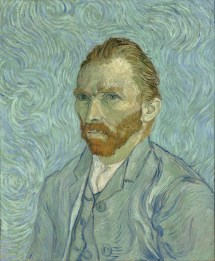
Vincent_van_Gogh_-_Self-Portrait_-_Google_Art_Project

Painters of the epoch-making film Loving Vincent “will probably hate that yellowish coat afterwards,” said Writer, Producer and Director Hugh Welshman, with a red beard resembling the artist he and Director Dorota Kobielahas worked on for the past seven years, in the UK and Ireland Premiere of the movie.

Van Gogh is Van Gogh. We know him by the Sunflowers, The Starry Night or his symbolic self-portraits together with the horrific story of his left ear. His works penetrate high school art textbooks; and he was probably, unintentionally, a significant contributor to the intuition of many that ‘artists are tragic’ — the way his story was told over the century and in the movie.

It is so to many contemporary artists, and that’s how it will probably be — Van Gogh is Van Gogh, no contemporary artists would try to imitate his skills, not to mention reworking of his subject matter to the day is a cliché. His style is so distinguishable that contemporary painters and artists wipe out every influence of it in their practices without actually knowing it. Perhaps except colleges, auction houses, galleries, and of cause Painters of this revolutionary film project, “learning to paint in the Van Gogh style and getting rid of their own styles” for the last two years of the post-production. (From the Q&A session at National Gallery on 9 October 2017).

Such re-creation of the style is no-doubt ambitious, in a positive way, that saves it from being cliché with an added layer of lively and engaging qualities underneath the frames. It is the team’s careful thought to bring forth Vincent’s story instead of Van Gogh’s, to the world through an enthusiast, like many of us, drowning in some ‘village gossips’. (I’ll have to stop at this point, don’t want to be a spoiler to some)

While the team describes it as an accomplishment, the legacy of the movie polymerises. The cooperation of Van Gogh Museum in Amsterdam and the production team sets a great example of Museology in a digital age.

I tell you, if one wants to be active, one mustn’t be afraid to do something wrong sometimes, not afraid to lapse into some mistakes. To be good — many people think that they’ll achieve it by doing no harm — and that’s a lie, and you said yourself in the past that it was a lie. That leads to stagnation, to mediocrity.

Vincent Van Gogh, letter to Theo van Gogh, Nuenen, Thursday 2 October 1884

It might be really helpful for those who’d like to know more about Vincent Van Gogh through his words, not his art:
http://vangoghletters.org/

It is certainly devastating to erase the traces of lemon yellow and Prussian blue while drawing new frames on another repeatedly; not only do the painters skilfully avoided the appearance of a green coat eventually, but the team found a neat balance between the two contrasting sides of the artist.

To see such an obsession to the old master and the attempt to remap his life is a remedy to art students in the 21st century who are lost in the contemporary art paradoxes. (But we’ll see.)

Here’s another story about the recruitment of the painters from Poland in 2014, which might explain a bit about the Polish UK co-production model and perhaps the ‘lost’ feeling:
https://www.theguardian.com/film/2014/mar/18/uk-van-gogh-film-polish-artists