Rethinking ‘the book’ as a medium

IMG_1668
only those we’ve encountered, existed. (2018)

I thought April 2018 would be the end of the project, after the realisation of how a person could be affected by this contemporary form of ‘stories’. You kind of drifted away from it when you discover the substantial amount of unnecessary information you forced yourself to receive daily. Whats more is during the process of typographing, binding, going through the substances over and over again amplifies the emotion embedded within the lines and images. Memories repeat and repeat until you want to emancipate your mind from it – that’s what I told my audiences who visited the exhibition at RSA.

But what happened recently in the hovering city have drawn my attention, once again, back to the social media. Being absent from the crime scene doesn’t mean that you could deny a crime was committed. It is experienced by million others – and things change, so as your self-consciousness and identity, your mind forged by images and your position moved by words – all begins at the moment you choose to process an information.

People expecting a storm can’t help checking on the forecast.
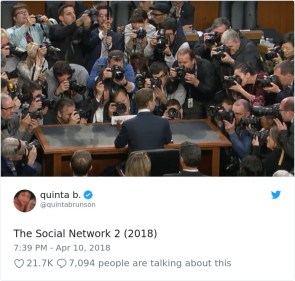
 

Facebook crisis: a catalyst for​ the rematerialisation of social life?

983791646239109120-png__700

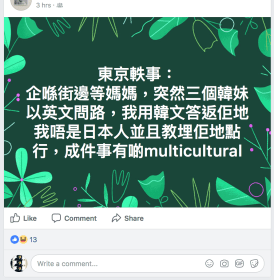
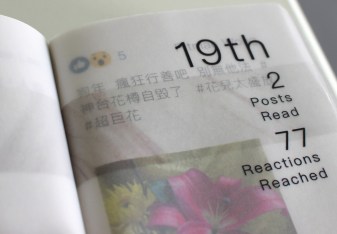
I have been capturing and arranging Facebook posts that I’ve read since January this year for my project. So recently, when the Cambridge Analytica incident fermented, I have been thinking about the nature of my project, and what my intention to record those information has to do with the life cycle of social media (identifying a need→born of an idea→establish of platform→thrive→new problem→disposal whether the whole platform of certain values→reidentifiying a need) reveals by the incident.

I must have had too much time to watch through the whole two-days congress testifying (aha!) but it pretty much tells the world about the nature of the business that ‘could not be categorised’. (werunadswerunadswerunadswerunads)

Apparently, the reality is, as it always have been in these days, more dramatic and severe than what creative individuals trying to create in their works. A renowned actor and one-act comedian in Hong Kong announced his retirement last year because “there isn’t a need for one-act comedies anymore”. The city, or at least his audiences, need not get to know the preposterous reality through his plays anymore.


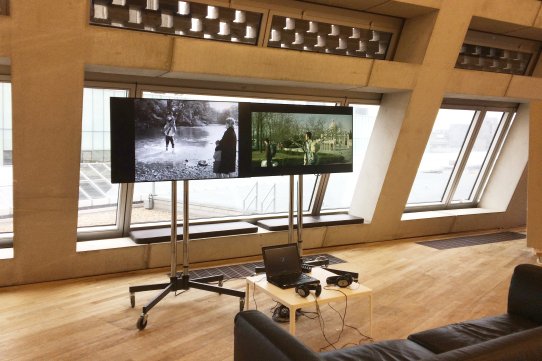
Audio work at Reading Assembly, Tate Exchange


IMG_2988.jpg
Utopia, Dystopia (2018), Film, Theatre & Television Department
School of Arts and Communication Design at Tate Exchange


Performing arts is a process of identity construction. It requires immersion into another experience and life in order to act vividly; playwrights do editing the plays – like storytellers edit the source of stories collected. In the process, creative decisions are made, new pieces of a creative expression are orchestrated, and, most importantly, they are made to be told / shown / performed.

I am delighted to be involved in Reading Assembly and to perform parts from Lungs by Duncan Macmillian and Oil by Ella Hickson. The plays discuss a mixture of vital social issues including ecology, politics, immigrants, etc. The plays provide a few stepping stone for analysing the authors’ viewpoint on these topics. The display, Utopia / Dystopia, at the Reading Assembly, Tate Exchange would be focusing on the ecology aspect. It will follow by a panel discussion on London 2050.

My Glossary: Physcology Terms

Keeping a Glossary helps to construct information for revisiting in the future; it might as well be a creative methodology that helps to locate a subject matter, or identify materials that could potentially become part of a work. This glossary is the physcology terms that I came across during my research for the Soul Bank project. They would be arranged into a graph at the end of my research:

Retrospective Memory Where the content to be remembered (people, words, events, etc) is in the past, i.e. the recollection of past episodes. Prospective Memory Where the content is to be remembered in the future, and may be defined as “remembering to remember” or remembering to perform an intended action. Multidetermination describes behaviors of any individual which are considered to be influenced by more than one variable such as genetics and environmental factors. Object Permanence (developmental physcology) is a child’s ability to know that objects continue to exist even though they can no longer be seen or heard by developing a mental representation of the object called schema (Originated Greek: skhēma, shape, plan), a category of knowledge about something in the world, e.g. an infant might have a schema for food, which during early infancy will be either a bottle or breast. Emotional Creativity the ability to experience and express original, appropriate, and authentic combinations of emotions. People with a high EC tend to generate original emotional reactions that benefit creativity (Ivcevic et al., 2007). Emotional Intelligence is characterized by the individual’s ability to identify, understand and express, regulate and use their own emotions and the emotions of others (Salovey and Mayer, 1990; Bisquerra and Pérez-Escoda, 2007; Peña-Sarrionandia et al., 2015). The processes of emotional regulation may favor an improvement of thought and enhance creative processes (Gross, 2013; Medrano et al., 2013).

Representation and construction of identities starts at an early age

Cheung0 Screen Shot 2018-01-18 at 4.03.40 PM.png

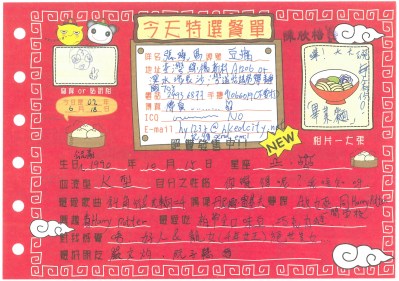
On the left:

In my primary and college school days, on the day of graduation we would give each of our fellow classmates a piece of, kind of a questionnaire to fill in, as a proof of friendship. There were two kinds of questions on the pre-printed questionnaire that the kids of my culture have to fill in: firstly their personal information, and secondly their impressions on the one who gave you the questionnaire. Most people would fill and return it, because they would also like to have their questionnaire back from the others too. Often there is quite some seen on the paper, such as ‘my pen is blue, my friend is you’ (a lyric from a pop song), Forever Friends (the Hallmark classic figure), etc.

The point I want to make is, we have been borrowing stuff from popular culture, symbols to consturct our own sense of affection and expression from an early age. Something that is not new, something we are already doing before the technological era.

Even I am reading my own hand writings now, I had no idea that I have ever written these kind of things before. I thank my generous childhood company who sent this back to me on my request.